
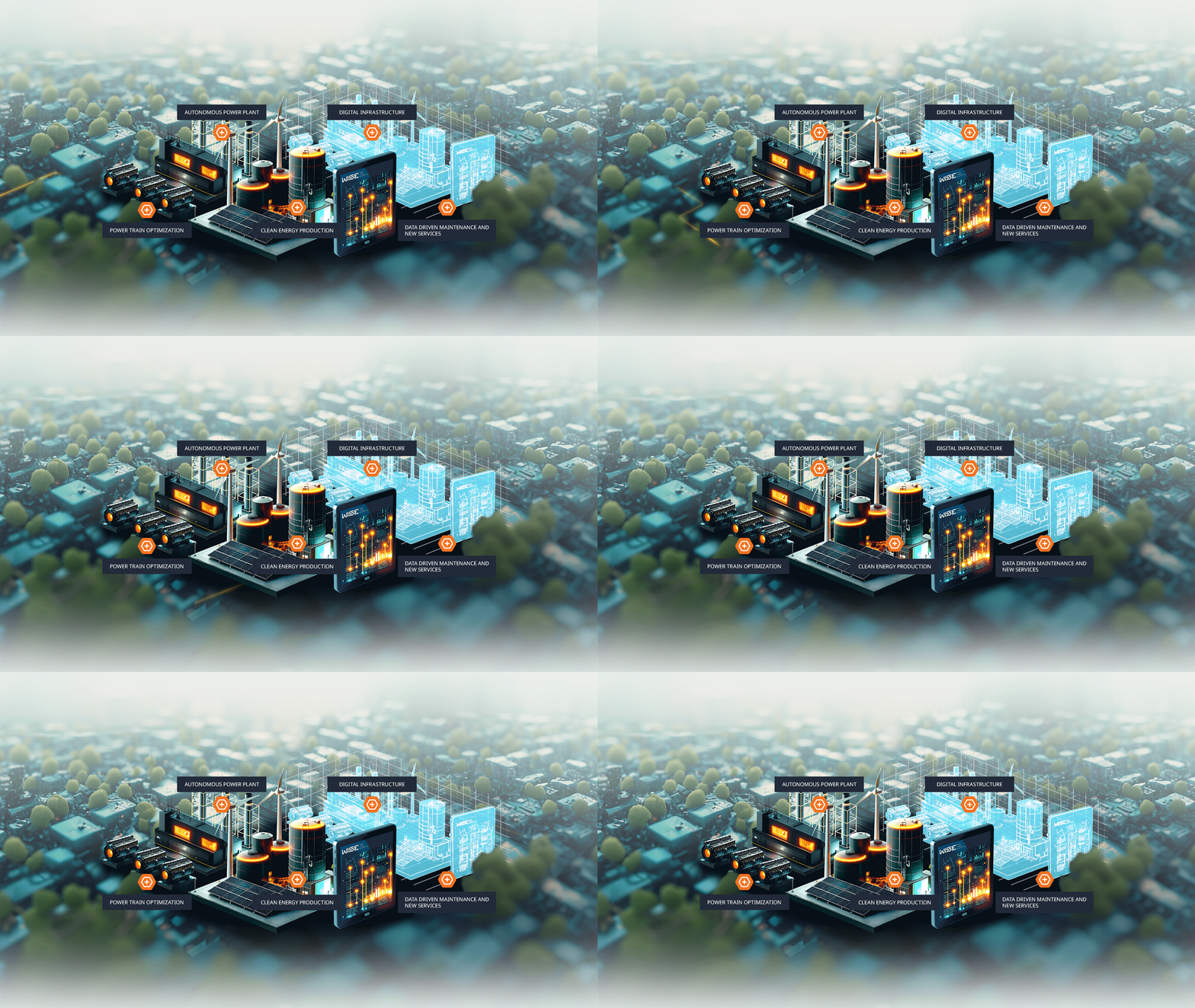
Power train optimization
Read more about this workpackage.
Projects in this workpackage:
BEST
Autonomous power plant
Read more about this workpackage.
Projects in this workpackage:
GCCS
EDE3
Digital infrastructure
Read more about this workpackage.
Clean energy production
Read more about this workpackage.
Projects in this workpackage:
iHAPC
MatH2
Ethanol Demonstration
METECH
Data driven maintenanve and new services
Read more about this workpackage.
Co-innovation
Description:
A co-innovation project developing the Hydrogen‑Argon Power Cycle (HAPC) using a closed-loop combustion process to enable highly efficient, zero-emission power generation. The concept replaces the nitrogen in air with argon, which significantly improves thermodynamic efficiency. With Hydrogen and oxygen as fuel and oxidizer respectively, the only product is water, while argon is continuously recycled. The project focus on enabling the technology on medium-speed engines for real-world power generation applications. The research is performed by a consortium, consisting of two universities, a research institute, and selected companies addressing different aspects of the HAPC challenge.
Goals:
Develop and evaluate the technology at lab-scale with a single cylinder medium speed engine, including full re-cycling of the argon. Optimize the concept by the help of simulations to gain both fundamental understanding and practical implications. Investigate the feasibility and impact of a full-scale HAPC power plant integrated into a combined energy storage and power generation system. Measure the real efficiency improvement and clarify main mechanical challenges.
Achievements:
Main part of the detailed process descriptions and safety analysis done. Detailed design and procurement of equipment ongoing. Lab and experimental build-up for HAPC started, with planned commissioning in first half of 2027. In parallel HAPC simulations ongoing focusing on different systems and aspects, with continuous input to the lab and engine implementation, additionally to gained understanding.
Partners:
Wärtsilä, University of Vaasa, University of Oulu, VTT Technical Research Centre of Finland, Parker Hannifin Manufacturing Finland Oy, Vahterus Oy, Vaisala Oyj and TotalEnergies.
Description:
This collaborative research project addresses machinery performance in energy and marine applications by advancing bearing, sealing and vibration control technologies. It investigates new materials and manufacturing approaches for gas bearings and seals, while also developing condition monitoring methods that support predictive maintenance. The work further aims to improve dynamic behaviour, reduce wear and extend equipment service life.
Goals:
The project aims to strengthen the efficiency, stability and sustainability of rotating machinery while extending equipment life. Predictive monitoring is used to reduce maintenance costs, and new bearing and sealing technologies are being developed to limit vibration-related failures and reinforce industrial hardware capabilities.
Achievements:
The torsional wire rope isolator/damper has delivered promising lab test results for energy and maritime applications. Thruster lip-seal monitoring has been defined, with the wear test bench ready and the face-seal bench starting. Initial testing of 3D-printed aerostatic bearings and seals confirms their technical applicability, while aerostatic backup bearing impact tests for kinetic energy storage systems are in progress.
Partners:
Aalto University, Wärtsilä, Valmet, Teraloop, Kongsberg, Tiivistetekniikka, Tiivistekeskus, Vibrol, Rosendahl and Nextrom.
Description:
The MATH2 project focuses on accelerating hydrogen adoption through advanced material innovation. It addresses key challenges such as hydrogen embrittlement, corrosion resistance and performance under high pressure and temperature. By combining modelling, laboratory testing and industrial validation, the project supports the development of safe, durable and efficient hydrogen technologies for energy and industrial applications.
Goals:
The project aims to develop and validate next-generation materials capable of operating reliably in harsh hydrogen environments. It seeks to improve durability, reduce material degradation risks and enable scalable hydrogen infrastructure. The work supports the transition toward flexible and decarbonised energy systems by ensuring long-term material performance and safety.
Achievements:
The project has been approved by Business Finland.
Partners:
EOS, Neste, Nordic Tank, Teknos, SSAB, Bumax, SP Stainless, VTT and University of Oulu.
Co-research
Description:
This research project advances measurement technologies for the accurate detection of gas-phase and particulate emissions. Its work addresses new fuels and low-emission technologies in cases where conventional methods are not sufficient. The scope includes greenhouse gases as well as harmful pollutants, such as ultrafine particles. The resulting solutions are intended to perform reliably in laboratory settings and under real-world field conditions.
Goals:
At its core, METECH is building the measurement capability needed for the next generation of fuels and low-emission technologies. The work focuses on detecting very low pollutant concentrations with precision, so emissions can be understood in real-world conditions and managed in line with tightening regulations. This knowledge supports cleaner energy and transport solutions on the path to zero emissions.
Achievements:
A measurement campaign targeting trace-level SO₂ emissions in ship engine exhaust was successfully conducted through collaboration between VTT and FMI at Wärtsilä’s Sustainable Technology Hub. In addition, intercomparisons of FTIR instruments provided new insights into the applied measurement methodologies.
Partners:
Wärtsilä, Energetica Suape II S.A. and Grupo Econômico 4M.
Description:
This research project uses advanced hardware-in-the-loop simulation methods to strengthen reliability in power systems. Modern approaches are being developed to verify grid-code compliance. With these methods, power system behaviour can be tested accurately across a range of operating conditions. The work helps integrate new energy technologies more safely and efficiently. It also contributes to WISE efforts to improve reliability at the system level.
Goals:
The project aims to establish simulation-based certification for power systems while improving the reliability and safety of grid-connected assets. By making compliance verification faster, more consistent and cost-efficient, it supports wider integration of renewable and distributed energy resources and advances the digitalisation of power system validation.
Achievements:
Comprehensive literature reviews have built a strong knowledge foundation and mapped current challenges as well as good practices in grid-code compliance. Advanced simulation models for grid-code testing have been created, allowing different scenarios to be analysed in a structured and repeatable way. Selected use cases demonstrate how simulation-based grid-code compliance testing can be applied.
Partners:
Danfoss, Business Finland, University of Vaasa, Kempower, Wärtsilä, VEO,Fingrid and Vaasan sähköverkko
Description:
A collaborative research effort is developing predictive technologies to strengthen engine safety and reliability. It establishes an approach for detecting, characterizing and preventing critical engine events in real time. The work combines on-engine monitoring with simulation models and advanced signal-processing methods. Experimental validation supports the creation and verification of representative fault scenarios.
Goals:
The initiative aims to identify and prevent severe engine failures as they emerge in real time. It also seeks to enhance predictive maintenance across energy systems, improve engine reliability and efficiency, and develop more advanced diagnostic and modeling capabilities. In doing so, it supports future energy systems that require greater safety and resilience.
Achievements:
The engine setup has been installed and commissioned, with reference tests completed for model validation. Fuel-injector failure tests are done, while bent connecting rod and piston seizure tests are planned. Healthy-operation modelling now includes a 3D ANSYS rigid-body dynamics model driven by measured cylinder-pressure data and a simplified rigid-body/state-estimation model with a PI controller. Bayesian inversion has begun to estimate parameters such as friction.
Partners:
Turku University of Applied Sciences, Wärtsilä, Nome Oy, AGCOPower Oy, Unikie Oy and EDRMedeso Oy.
Other projects
Description:
This demonstration project in Brazil is testing the world’s first large-scale engine powered by sugarcane-derived ethanol. Using a modified Wärtsilä engine at the Suape II power plant, the trial evaluates ethanol as a clean, reliable and dispatchable fuel for power generation.
Goals:
The project will demonstrate that ethanol can serve as a viable fuel for large-scale power generation by proving engine performance, reliability and emissions in extended testing. By doing so, it expands the range of sustainable fuel options for power systems, supports locally produced renewable fuel and contributes to lower-emission electricity generation.
Achievements:
The engine conversion has been completed to enable the use of ethanol as fuel. International interest in ethanol as a fuel has grown, supporting broader awareness of its potential in sustainable fuel applications.
Partners:
Wärtsilä, Energetica Suape II S.A. and Grupo Econômico 4M.